Magic
Magic is the mage path. You build a staff, wand or blade out of parts at a Magic Station, slot spell runes into it, and then attune it to one of ten elements by feeding it magical energy you gathered from a shrine. Your character also carries a personal Resonance score in every element, and a weapon will simply refuse to fire if your Resonance is too low for what it holds.
Last modified:
The words
Five words you need before anything else makes sense.
| Term | What it means |
|---|---|
| Element | One of ten flavours of magic: Cerrith, Oseni, Seithr, Mitlan, Bloodmagic, Spirit, Arcanum, Illusion, Necromancy, Shadowmancy. |
| Resonance | A 0-100 score your character holds in each element separately. It decides whether a weapon will accept a charge, and it scales the mana cost, damage and cooldown of your spells. |
| Aura | The physical resource. It lives inside artifacts and charges, is gathered from shrines, and is spent to attune a weapon. Aura in an artifact never decays. |
| Socket | A hole in a finished weapon that one spell rune fits into. Sockets come in four sizes: Minor, Lesser, Greater and Ascendant, and a socket takes a rune of its own size or smaller. |
| Attunement | Locking an element into a weapon by spending a charge on it. Until you do, the weapon holds no element and refuses to cast. |
It is per character, not per account
/resonance refuses to open at all without an active character.The loop
The intended loop, start to finish.
- Be a Mage. The Mage class is what gates Mage Staffs, Mage Wands, Mage Blades and Mage Armor. Its own description warns that mages are expensive to gear.
- Open
/resonanceand pick a cast mode: Surge ("Power now. Corruption later.") or Flow ("Slow start. Stronger at depth."). Flow is the default. - Craft and place a Magic Station, then interact with it to open the assembly menu and build a weapon out of parts.
- Slot runes into the weapon's sockets. This is where spells come from; a weapon with no runes casts nothing.
- Build a shrine and put an artifact on a pedestal in it to soak up aura.
- Imprint and fill a charge on that same pedestal.
- Spend the charge on the weapon at the station, which starts the orb minigame that decides how much of the charge actually sticks.
- Hold the weapon and use the rune's casting key to cast. The default is right-click.
The Magic Station
A plain vanilla 3x3 craft. Anyone can make one.
Magic Station
Crafting TableRequires: None


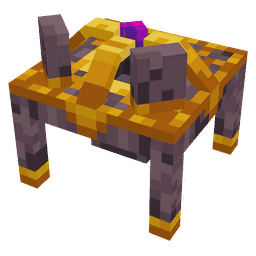
Place it, then interact to open the weapon assembly menu.
The Rune Station
A second vanilla 3x3 craft: the Magic Station pattern without the Amethyst Shard. Anyone can make one.
Rune Station
Crafting TableRequires: None
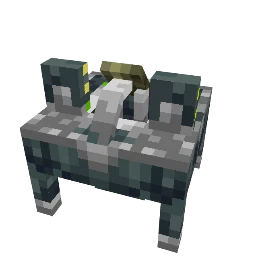
Place it, then interact to craft blank runestones and Enchanted Charges from Enchanted Dust.
The Rune Station turns Enchanted Dust into blank runestones, armor runestones and Enchanted Charges. Every recipe takes 10 seconds and needs nothing but dust.
| Tier | Runestone | Armor Runestone | Enchanted Charge |
|---|---|---|---|
| Minor | 4x Enchanted Dust | 16x Enchanted Dust | 4x Enchanted Dust |
| Lesser | 8x Enchanted Dust | 32x Enchanted Dust | 8x Enchanted Dust |
| Greater | 12x Enchanted Dust | 48x Enchanted Dust | 12x Enchanted Dust |
| Ascendant | 16x Enchanted Dust | 64x Enchanted Dust | 16x Enchanted Dust |


Which rune fits which gear
A socket takes a rune of its own tier or any tier below it. It never takes a bigger one.
| Craft quality of the gear | Socket it gets | Rune that fits |
|---|---|---|
| Rusted | None | Nothing |
| Tempered | Minor | Minor |
| Polished | Lesser | Minor, Lesser |
| Gleaming | Greater | Minor, Lesser, Greater |
| Masterwork | Ascendant | Any tier |
- The socket comes from how well the piece was crafted, not from its material. Iron Mage armor can take an Ascendant Armor Rune, but only if that piece came out Masterwork. A Tempered iron piece has a Minor socket, so a Minor Armor Rune is the most it will ever hold.
- Armor runes go on Mage armor only. Every other armor piece has a Gemstone socket instead, and an armor rune will not fit it.
- Armor runes and weapon runes are separate: an armor rune never fits a staff, wand or blade, and a spell rune never fits armor.
- A smaller rune in a bigger socket works, but it uses that socket up. If a piece has several sockets, the rune goes into the smallest one that can hold it.
- Check the socket line in the item's lore before you spend the dust. It names the biggest size the piece accepts.
Quality is decided while smithing, see Advanced Crafting.
Archetypes
Three weapon shapes, each wanting a different set of parts.
| Archetype | In-game name | Melee: | Parts it needs |
|---|---|---|---|
| Staff | Mage Staff | No | Core, Handle, Tome x3 |
| Wand | Wand | No | Core, Handle, Tome |
| Sword | Mage Blade | Yes | Core, Handle, Tome |
Enchanted Charges
A charge is a consumable, not an artifact. Put it on a pedestal in a shrine and it is imprinted with every element that shrine scores, then filled from it.
Charges are crafted at the Rune Station from Enchanted Dust: 4, 8, 12 and 16 dust for tiers I to IV.


A weak shrine cannot fill a high-tier charge. That is the tier gate. The band printed on a charge ("Cerrith II") is just a readout of how much aura it holds: under 10 shows a dash, 10 is I, 40 is II, 75 is III, 110 is IV.
The orb minigame
Applying a charge to a weapon does not just write the attunement. It starts a timed minigame, and the charge is spent up front whether you win or not.
Orbs circle you. Pale blue orbs are good: hit enough of them before the window closes and the weapon settles, holding a percentage of the charge. Rust-orange orbs tear the weapon: each one you hit adds +5 persistent Rift, capped at 100. Missing a good orb costs 8% of the run. Disconnecting mid-run ends it with whatever you had.
A charge can exceed your Resonance
- Rift per bad orb
- +5capped at 100
- Rift removed per later recharge
- 10never on the first charge
Rift persists until reduced by a later recharge
Casting
Hold the weapon and use the rune's casting key. The default is right-click.
To change a rune's casting key, hold the rune and use /magic rune keybind.
| What you see | Why | What it costs you |
|---|---|---|
| *Whiff* | Your Rift rolled against you (or the rarer "Too many staffs" message). | Mana and the cooldown, both already spent. |
| *Refused* | Your Resonance is below what the weapon asks, or the weapon holds no element at all. | Nothing. |
| *Damaged* | A config change left the weapon holding runes it can no longer seat. | Nothing, but the weapon will not cast until you reclaim its runes. |
A refusal explains itself in chat: "The weapon asks for {element} {need}. You carry {have}.", but only once every 30 seconds per weapon and element, so do not expect a message on every click. To fix a Damaged weapon, right-click an empty Magic Station: it works the loose runes free and hands them back.
Meditation and Mental Points
Shrines do not only fill artifacts. Standing in one and meditating is how you raise your own Resonance.
- Resonance per orb hit
- 4.0
- Mental Point cost per hit
- 1
- Mental Point pool
- 150shared with Research
- Regeneration
- +10 / houroffline too
Mental Points (also called Focus) are a shared pool spent by both Magic meditation and Research experiments. Wisdom adds +0.5 per hour per point and Intelligence +0.25. A full pool of 150 takes fifteen real hours to refill and buys 150 orb hits. That is 600 potential Resonance before element caps, shared-artifact division and session limits.
Resonance bleeds, and artifacts get tired of you
Storing an artifact in a chest raises its muffle, silently. Safe places are your own inventory, a pedestal, an artifact display, or an item frame.
Commands
View your Resonance profile and change a rune's casting key.
| Command | Aliases | What it does |
|---|---|---|
/magic rune keybind | None | While holding a rune, use this command to change its casting key. |
/resonance | /res | Opens your Resonance profile: a bar per element, your Equilibrium (Corruption vs Tranquility), your Mental Points, and the Surge / Flow cast-mode toggle. |